
News

News

Commercial Production is Turned into a Demonstration in Hanwha Vision’s “Now You See” Campaign

Sep. 17, 2026


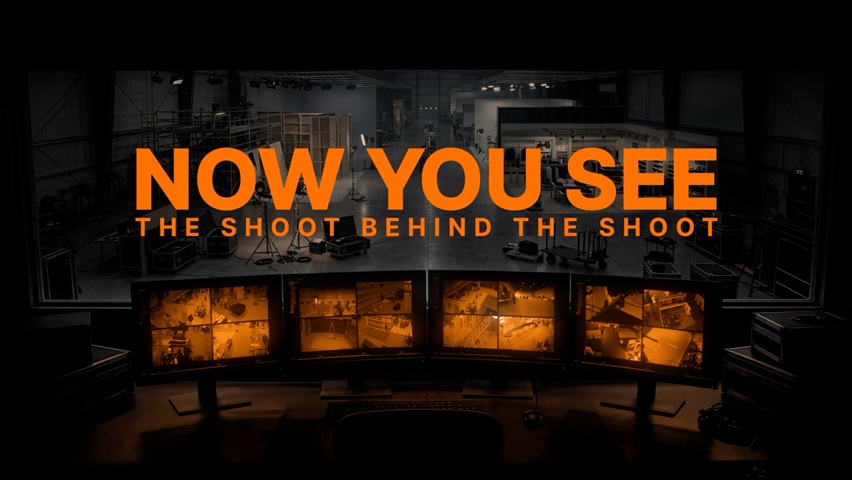
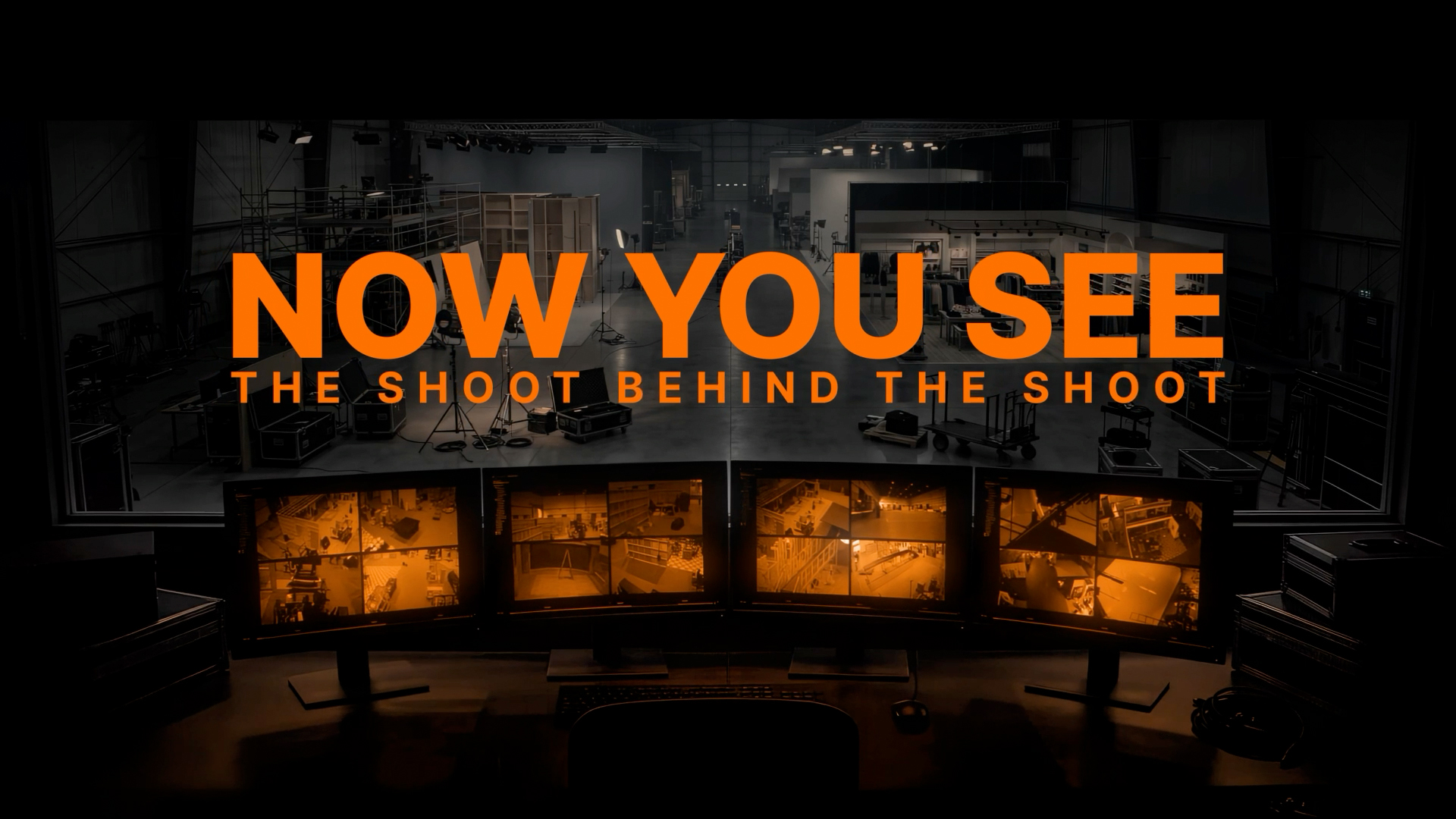
Global vision solutions company Hanwha Vision teamed up with Cheil to test its AI-enabled cameras and software on a film set while shooting a commercial, starring Hollywood actress Amanda Seyfried. To establish how Hanwha Vision’s AI vision solutions can serve a variety of businesses and industries, Cheil turned the conventional commercial production into a demonstration.

Hanwha Vision’s commercial, directed by award-winning director Michael Gracey, shows off its latest innovations as the story follows the actress navigating a larger-than-life screen test. While filming the commercial, Hanwha Vision’s own technology was put to the test.

The entire commercial production was engineered to prove how Hanwha Vision’s AI vision solutions can help run a safe and smooth shoot. A total of 42 AI-enabled cameras were installed on set prior to any crew activity. Throughout the production, the cameras and software monitored, recorded, and analyzed every inch of the soundstage.

Tal Shub, Global Executive Creative Director at Cheil Korea, said, “Using the product in an unconventional way is what makes this work truly stand out in the category. The teams at Cheil and Hanwha Vision crafted a campaign that doesn’t just deliver a memorable message — it proves the real power of the technology.”  

Hanwha Vision’s cameras and software captured high resolution video and detailed data 24/7. People, movement, safety, workflow, and operational behavior were analyzed in real time to improve the efficiency on set. 

The film set was chosen as the best environment to prove Hanwha Vision’s technology due to its complexity and having all the challenges of many industries in which Hanwha Vision provides solutions, including traffic, access, crowd flow, and asset protection.

The resulting footage and data from the film set became the campaign’s centerpiece across all mediums including behind-the-scenes content, social posts, out-of-home, campaign website, and trade show materials.

“This campaign was never just a commercial — it was living proof of what our AI vision solutions can do. 42 cameras, 7,014 hours of footage, and 319 people on a working soundstage gave us the most demanding test environment we could ask for, and our technology delivered,” said Hanwha Vision. 

The global campaign “Now You See” will run throughout the year. Cheil Korea is the creative agency.

View “Now You See” case study:


View “Now You See” commercial:


Insight

Port in a Storm

Jul. 30, 2026

The brands that will survive the great commoditisation aren't the ones trawling the deep end. They're the ones wise enough to offer shelter.

By Kunal Ghosh, General Manager – Strategy, Cheil South West Asia

There is a German word, Weltschmerz, that translates roughly as “world-pain”: the ache you feel when reality refuses to match the life you were quietly promised. We are, at present, living inside that ache. Markets lurch. Jobs dissolve into algorithmic mist. Conflicts that once felt geographically distant are suddenly local. There’s a persistent feeling of dread and anguish that the Danish film Another Round captured hauntingly, “I have not been okay for a long time.”

In response to this, brands have done largely nothing. Most are still selling. They have continued to retarget shamelessly across vulnerabilities, to feed recommendation engines rather than human memory, to build factories churning scroll-stopping creative and influencer pipelines. The marketplace is louder, faster, and more technically impressive than it has ever been. It is also less trusted than it has ever been. Brands gained precision and lost humanity. I call it a warmth crisis.

As an industry we have become extraordinarily good at reaching people yet remarkably ineffective at reassuring them. We are confusing signal strength with emotional presence, obsessing over number of contacts while it is the quality of contact that should matter. Ipsos’ recent global research mentions Empathy as a driver of brand success, quoting “people feel close to a brand is likely driven by the empathy projected by the brand.” People feel close to brands that project care, the ones with harbour lights on.

The way forward through the way back

When the ground shifts, people don't go shopping. They recoil. They return to places, moments, and people that once felt recognisable because it is known. 

Like watching reruns of The Office and Seinfeld while there are new titles released on Netflix each week. Like anti-trend fashion with vintage clothes or personal choices getting preferred over the latest “core” on Instagram. Like adults investing in toys or comics as a ‘permission slip’ to be unproductive and agenda-less. Like choosing record over the stream, the paper notebook over an app, the handwritten note over the email. Rather than stepping backward, we are going inward. It’s a structural shift toward legibility.

Svetlana Boym writes in her book The Future of Nostalgia about its two forms: the restorative kind (nostos), which tries to reconstruct the past such as the old logo revival, or the relaunch of a discontinued heritage product. The reflective kind (algea), which dwells in the longing and the feeling of the past. The brands worth mentioning are doing the latter by carrying its emotional register forward.

In simpler words, they bring alive a feeling of “the simpler times”.

The many manifestations of the simpler times

At the level of brands, I have seen this idea taking four distinct forms:

Social simplicity is the promise of fewer, deeper connections over aimless networking. It’s the antidote to the set expectations of our times. Heineken’s “social networking since 1873” is one of the best examples of a brand going against the current and restoring the magic of meeting strangers in a bar over a beer. In a category that considers ‘occasions’ as the ultimate success metric, they are betting on depth over frequency which is rare for a brand of that statute.

Emotional simplicity is the warmth, kindness and predictability at a time of volatility. IKEA, as a brand or as a store, doesn't sell furniture so much as it encapsulates the feeling of being looked after. Whether it’s about helping through new parenthood or comforting a baby monkey in a zoo, anything that IKEA does feel like something a family member would; like an embodiment of the spirit of Hygge. In a distant category, another brand does this in a completely different manner. Heinz sells certainty that a table will have a known taste anywhere you go. The emotional contract is the predictability of the experience, and the reassurance that some things will still be what they were.

Cognitive simplicity is the gift of fewer choices. It brings clarity in a world full of overwhelming options. “Weniger aber besser” (less but better) as the legendary designer Dieter Rams had prophesized all those decades ago. Muji's founding philosophy mujirushi ryohin, ‘no-brand quality goods’ was a revolt against consumer excess since the 1980s. To this day they are living up to that promise of bare essentials and nothing more. The Ordinary did a reset on the beauty industry’s fixation with mystification when they stripped the category down to the essentials with products named after active ingredients and percentages like Hyaluronic Acid 2% + B5. The transparency and reduction of overload was the brand’s disruption.

Temporal simplicity is perhaps the most subversive of all: the invitation to stop. The permission to slow down in a culture obsessed with speed. While KitKat's seventy-year-old positioning "Breaks are good for you" is the first thing that comes to mind, the most unique case I can think of is Guinness. They made the two-minute pour, the wait for the “Good Things” a part of the brand ritual. Can’t help but praise the famous 1999 ad “Surfer” which showed how waiting for the right wave and the right pint are both justified. At a time of rush, they held the line. The gratification became more when it was not instant, patience itself became a form of pleasure.

No such thing as nostalgia marketing

The cultural theorist Mark Fisher offered a term: hauntology, a critical view that our culture is haunted by futures that never arrived: that we're living in a present which borrowed its aesthetics from a remixed version of the past. 

It is a fair challenge to the argument of ‘the simpler times.’ Brands that are trying to create a sense of the past will risk trapping themselves in a cycle of old ideas, which ultimately blinds them to new horizons and promotes a culture of cocooning.

The answer lies in the distinction. What Hauntology points at is the cynical approach: the brands that sell nostalgia as spectacle. The ones that borrow the aesthetics of the past as a shortcut to run its next marketing campaign. The ones recreating that retro look or a grainy filter or a creative brief that says "make it feel like the nineties but target Gen Alpha anyway." We have witnessed enough brands jumping onto this “nostalgia marketing” bandwagon with cheap tricks like the old logo revamp or referencing a cultural moment they have no connection with. That is not shelter, that is set dressing.

The brands I am arguing for are doing something more fundamental. They are finding the emotional truth underneath memory such as belonging, clarity, the feeling of being protected and cared. They revisit the assurance that simpler times were possible and therefore still are.

The clear choice: commodity or sanctuary

The Edelman Trust Barometer has, for years now, tracked the steady erosion of institutional trust. Kantar's 2026 marketing trends paper identifies trust as the primary currency of brand growth. Ultimately, trust comes from presence.

As consumers increasingly delegate decisions to large language models, brands will invest more in algorithmic visibility such as sponsored citations, paid recommendations, and machine-readable content real estate. They will increasingly find themselves reduced to a line on a list. In a spreadsheet, you have a transaction with the cheapest option that clears the minimum criteria instead of a relationship.

While many brands will continue optimising for attention, efficiency, and conversions at cost of becoming a commodity, a few will offer emotional sanctuary. They will be disproportionately valued because they were there. While the rest were busy selling, they sold the feeling of being held.

They turn out like a memory. A ritual. A feeling. A known face. A timeless place. Less interruption, more intimacy. Less persuasion, more presence. Less spreadsheets, more spreading hope.

Though this Weltschmerz in reverse, as one might call it, is perhaps something even quieter, it is the recognition that the world still contains pockets of warmth, and that some of it arrives in the shape of a shareable chocolate bar, a cold beer with strangers, a car that takes you home on the holidays, a store door that opens into somewhere familiar, a playlist that sounds too personal to have been curated for anyone else. 

These brands, however rare they are, feel like refuge at time when the whole world is feeling displaced. They leave the door open. They invite, saying, “Come in. It’s a perfect day. There's coffee brewing. Music playing. You are at home here. In some way that matters, you always have been.”
Insight

From estimation to verification: Hey Dealer "Used Cars: What You See is What You Get"

Jul. 9, 2026

By Wonjeong Jang, The SOUTH Team 2, Cheil Korea


'Hey Dealer Revolutionizes the Used Car Market'

From a successful launch to the groundbreaking "I'm Going to Break Free" campaign that reinvented how we value used car purchases, Hey Dealer has consistently shattered industry conventions and set new standards.

But here's the challenge: Considering the used car buying and selling cycle, consumers engage with this service perhaps once every three years. So how do you make innovation a daily reality rather than a once-in-a-lifetime experience?

That's why this campaign decided to answer not with lengthy explanations, but with a shocking proof by revealing the tangible reality itself.

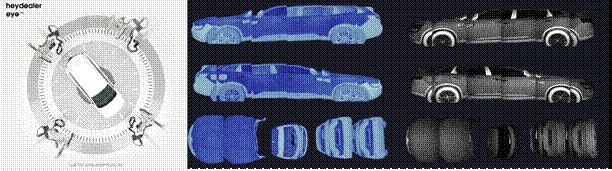
A technology that ends the "age of estimation," where we could only guess a used car's condition based on paperwork, and opens the "age of verification," where we can see directly with our own eyes: An MRI for used cars.

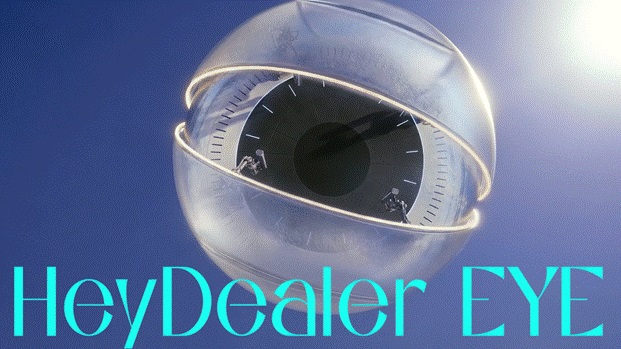
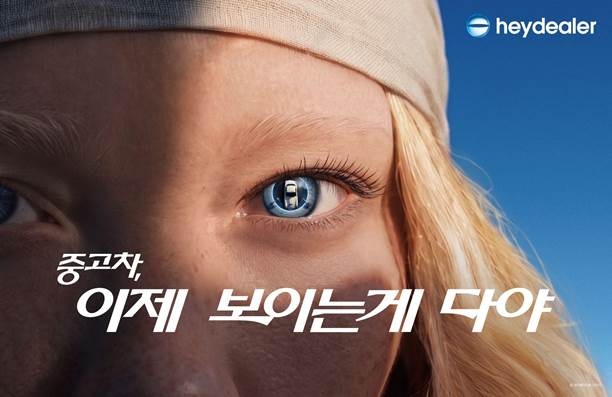
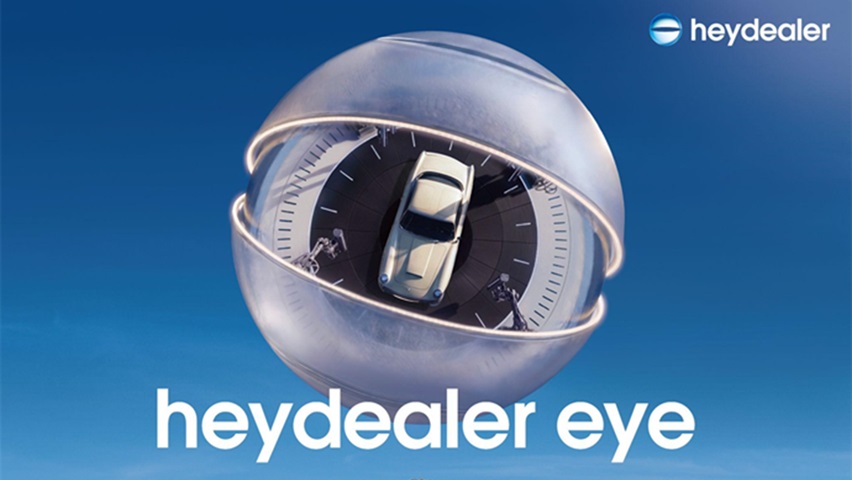
Introducing Hey Dealer eye which is Korea's first thermal imaging-based vehicle AI diagnostic solution.


※ Source: Hey Dealer official website


The Remarkable Future Ahead We Will See Through 'New Eyes'

We needed to establish a sense of arrival that through Hey Dealer 'eye,' people would experience a fundamentally a new way of seeing used cars.

In the film, rather than listing technical specifications, we preserved Hey Dealer's signature voice while delivering a completely fresh visual shock to convey eye's innovation with genuine impact.


A Sci-Fi-Style Birth: The Eye that Became a Spaceship

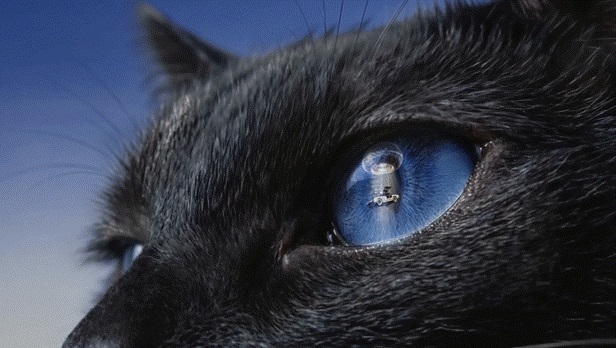
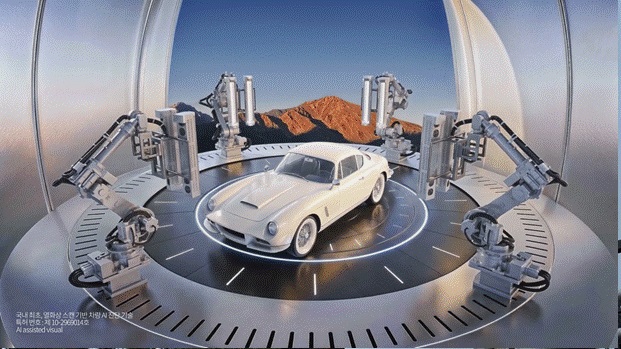
First, we infused imagination so eye wouldn't appear as merely a scanning device. Instead, we depicted it as an overwhelming, monumental form like a UFO from a science fiction film.

Through a dramatic sequence of a UFO appearing and absorbing an entire used car, meticulously scanning its interior, and finally implanting that vision into human eye, we gave eye a strange yet powerful birth narrative.


This Isn't a Machine. It's a New Eye.

True to the naming, another critical element was creating an intuitive visual connection between the device and the human eye. The fact that the "eye" takes the form of a human eye and embodies the value of human insight makes it uniquely differentiated from any other scanning device.


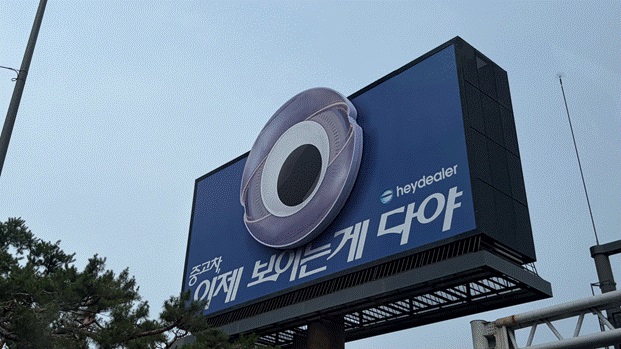
This message received full support through multi-channel IMC promotions, from outdoor media to collaborations with creator Kim Eyeball, delightfully and decisively amplifying the character of the "eye" as a true eye.


※ A giant eyeball affixed to a billboard near the Hannam Bridge intersection


Innovation Deserves Innovative Production Methods

This film made particular use of AI creative to express Hey Dealer eye's technological sophistication with precision and intuition. However, we discovered limits in AI's ability to render the intricate details within eye itself, so we compensated with 3D graphics and post-production refinement to achieve subtle realism.


Finally, Adding Two Spoonful of Humanity

Alongside AI creativity and the technological marvel of the eye, we faced one concern: The coldness and distance that technological innovation can convey. So, we deliberately preserved human warmth.

First: the human subject.

We took great care to escape the artificial perfection inherent to AI-generated imagery.

Above all, the realism conveyed by freckles and fine wrinkles, combined with an unconventional styling that creates a mysterious aura making it hard to pinpoint the character’s nationality, resulted in a unique character who feels plausible yet unreal.


Second: the BGM.

We incorporated Louis Armstrong's timeless classic "What a Wonderful World," adding an emotional touch that breathes warm soul into cold machinery. Behind this choice lies deeper meaning which is Hey Dealer's vision for the ideal used car world the brand wants to build.

Particularly clever is how the lyric "I see trees of green, red roses too" naturally blurs 'I' into 'eye'—a subtle easter egg conveying the core message that the eye reveals what was previously invisible. It is a small but intentional nod.


Used Cars: Now, What You See with the Eye is All There Is


Until now, buying a used car meant relying solely on service records and paperwork history. But the arrival of the 'eye' is about to bring remarkable change to the used car ecosystem. A new world is already unfolding before our eyes, one where hidden repair marks become visible, and consumers can purchase used cars with genuine confidence.

We hope you'll look forward to experiencing the transformed used car market you'll discover through Hey Dealer eye.

Insight

The future of work will not be achieved by decree

Jun. 22, 2026

By Jo Hayes, Barbarian, Executive Director of Strategy & Data

There's a particular kind of memo making its way through companies across all industries right now. You know the one – everyone pulls it up to show their friends at happy hour or brunch and rolls their eyes as they read it aloud. It announces that the organization is "transforming into an AI-first company," that every team will "integrate AI into their workflows," and that this is, “effective immediately, a priority”. The message ends there, though. No one tells you which workflows or what part of your work that actually involves. The mandate arrives like a pop-up thunderstorm and disappears just as fast, leaving only a mess in its wake.

While I disagree with the communication style, I understand the urgency behind it. AI skills have, for the first time, become the most difficult for employers to find globally, surpassing traditional IT and engineering, according to ManpowerGroup's most recent global talent report. Roughly 72% of employers say they're struggling to hire the talent they need. The capability gap is real, and the pressure leaders feel to close it is legitimate. But the response to that gap being top-down decrees to "use AI more" is, I'd argue, one of the sloppiest and least respectful things a leadership team can do to its own people. 

I don't use those words lightly. I mean sloppy in the specific sense that a blanket mandate skips the actual work of understanding. And I mean disrespectful because it presumes that the problem is a team’s unwillingness to adopt a tool, rather than the possibility that no one has bothered to learn what their day actually looks like.

When AI is introduced through blunt force, it often creates resistance for reasons that have little to do with the technology. People do not push back simply because they are afraid of change. They push back when they feel unseen. They push back when the people asking for transformation do not seem to understand what their day actually requires. They push back when “efficiency” isn’t defined or understood, or when a tool is presented as a solution before anyone has bothered to understand the problem.

Here's what a mandate misses. Work is not a list of tasks waiting to be automated. It's a system of dependencies, handoffs, judgment calls, and accumulated context (much of it currently invisible). 

This is the part that matters most to me, especially in a business like ours, where the entire premise of our work to be done is connecting with communities, generating emotion, and moving people to act. We ask our talent to bring genuine curiosity and care to understanding the audiences we serve. We study their behavior, their friction, their unspoken needs, before we ever propose a solution. There would be obvious hypocrisy in turning around and handing our own talent a context-free directive. We owe our workforce the same ambition and care we ask them to show the world.

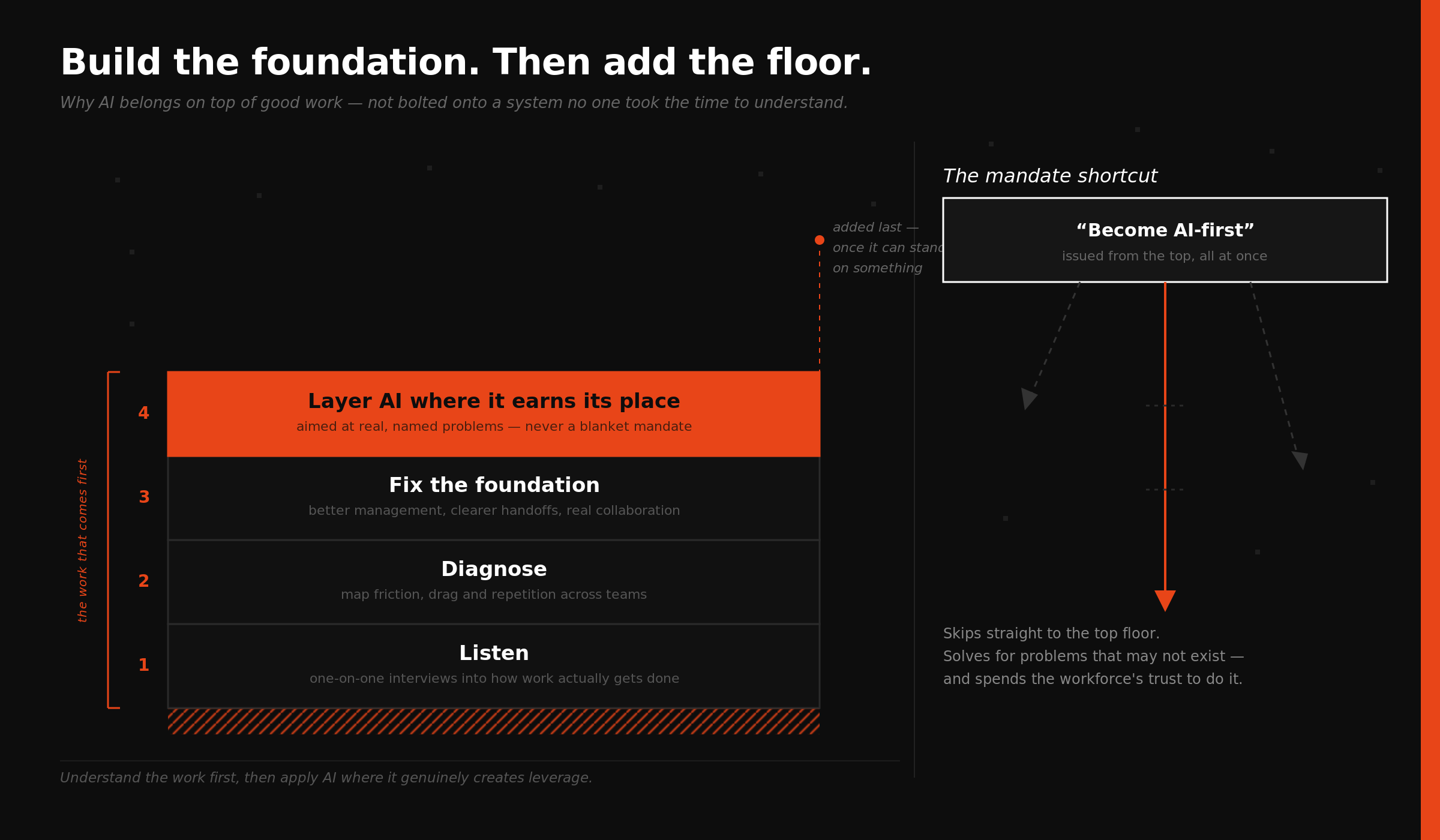
That conviction is why, at Barbarian, we're not starting our AI effort with a tool rollout or a survey of who's using what AI tools. We're starting with conversations. We're running a structured listening sprint across the agency as one-on-one interviews designed to surface where people actually lose time, momentum, clarity, and energy. We ask people to walk us through their real work: what takes longer than anyone realizes, what requires the most judgment, where the same thinking gets repeated, where context is trapped in a single person's head. We are deliberately not asking, "have you tried using AI for that?" Because the moment you lead with the tool, you stop learning about the problem.

AI can create enormous leverage in those moments, but only if it is aimed at the right friction.

There is a meaningful difference between “How can AI make this faster?” and “What is making this harder than it needs to be?” The first question assumes the answer. The second question respects the work. That respect is an operational necessity.

What’s produced is a map: where friction lives, by discipline, by level, by how people work. That map tells us where to invest in process, in tooling, in training, and YES, in AI — where it genuinely creates acceleration rather than theater. 

The irony of AI transformation is that it has to start with humanity. AI will absolutely change how we work. But if we want that change to be meaningful, we have to stop treating people as the barrier to adoption and start treating their experience as the data.

The mandate should be: understand the work deeply enough to make it better. AI can help us do that, but only if we are willing to listen first.


News

Beer brand Cass partners with Cheil for the global tournament campaign honoring wide-mouthed football fans

Jun. 17, 2026


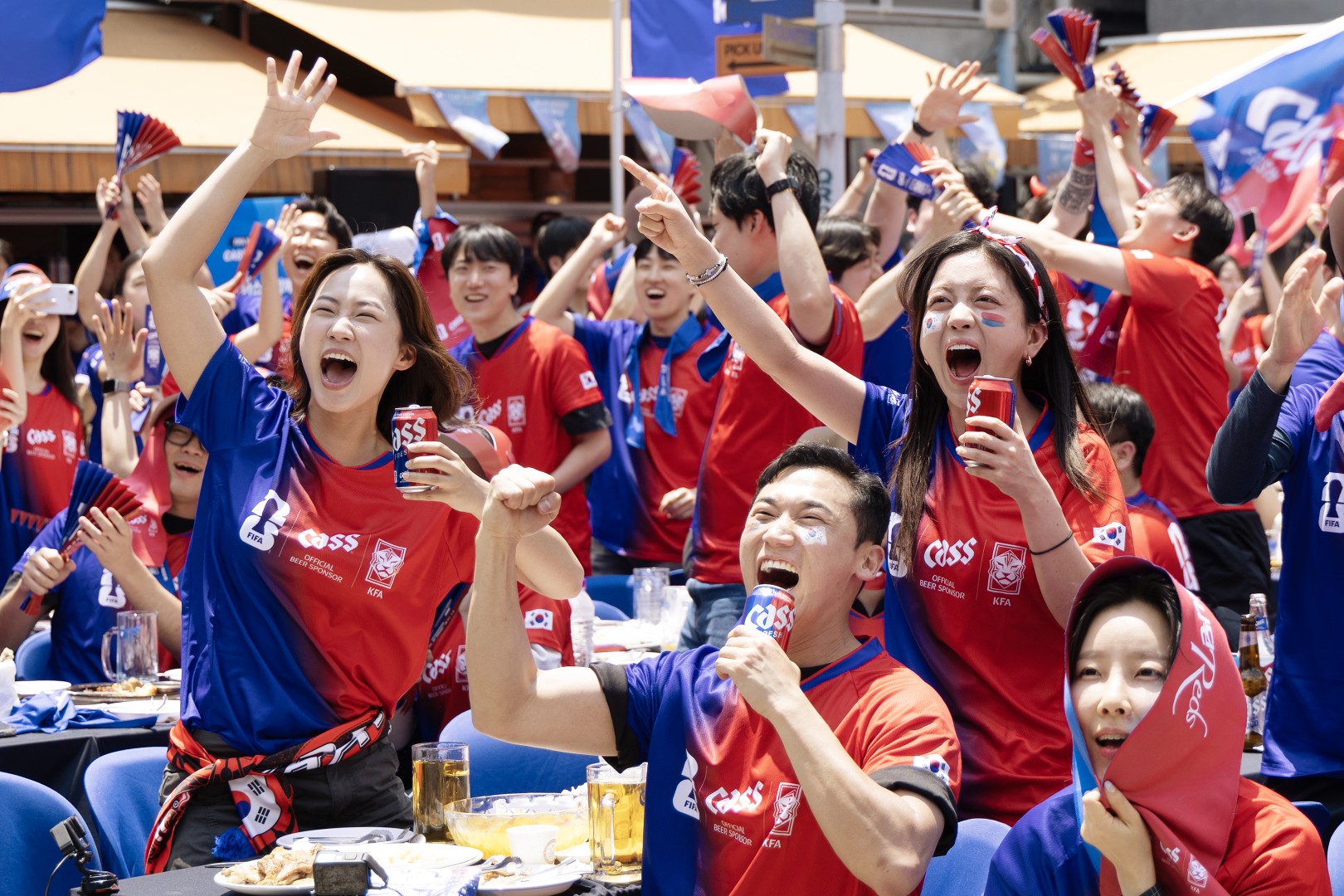
Cass, South Korea’s best-selling beer brand, and Cheil are hosting the “Wide Cup,” a competition to see who opens their mouth the widest while watching the games, to promote the brand and build excitement for the global football championship.

Cass, the official partner of the South Korea National Football Team, is launching various consumer events and activations with the tagline "The Moment 50 Million Become Real." The associated Wide Cup campaign establishes the brand as an essential part of collective celebration, while offering fans tangible rewards.

Football matches are usually watched in the evenings over a beer after work. However, for the first time in the big game’s history, all of the South Korean national team’s group matches are being held on weekday mornings. 

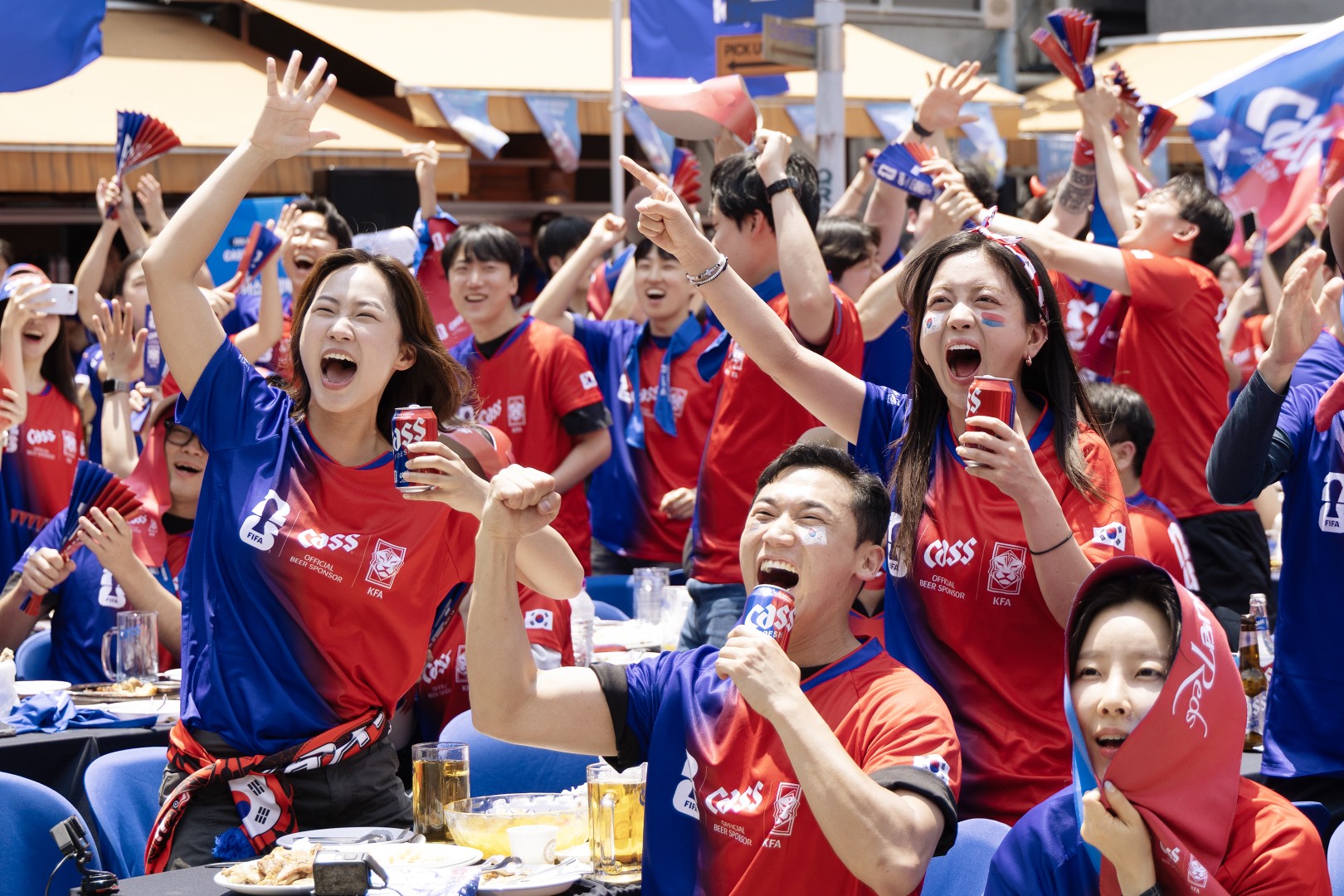
To provide a venue and atmosphere where people can gather and cheer on the team, Cass has brought forward the opening times of pubs across Seoul to create spaces for fans, and hosts the Wide Cup event on the days when South Korea plays to offer rewards matching the size of fans' mouths.

At the viewing parties organized by Cass, pictures of fans cheering will be taken. Using AI technology, Cass will measure the size of their mouths on-site, and award one can of its flagship non-alcoholic beverage Cass Zero for every 1mm of mouth size. The more enthusiastically fans cheer, the greater the reward.

Furthermore, the most passionate fan reactions from every group match will be made into outdoor ads and displayed across Seoul throughout mid-July, giving consumers the chance to appear in Cass’ OOH campaign.

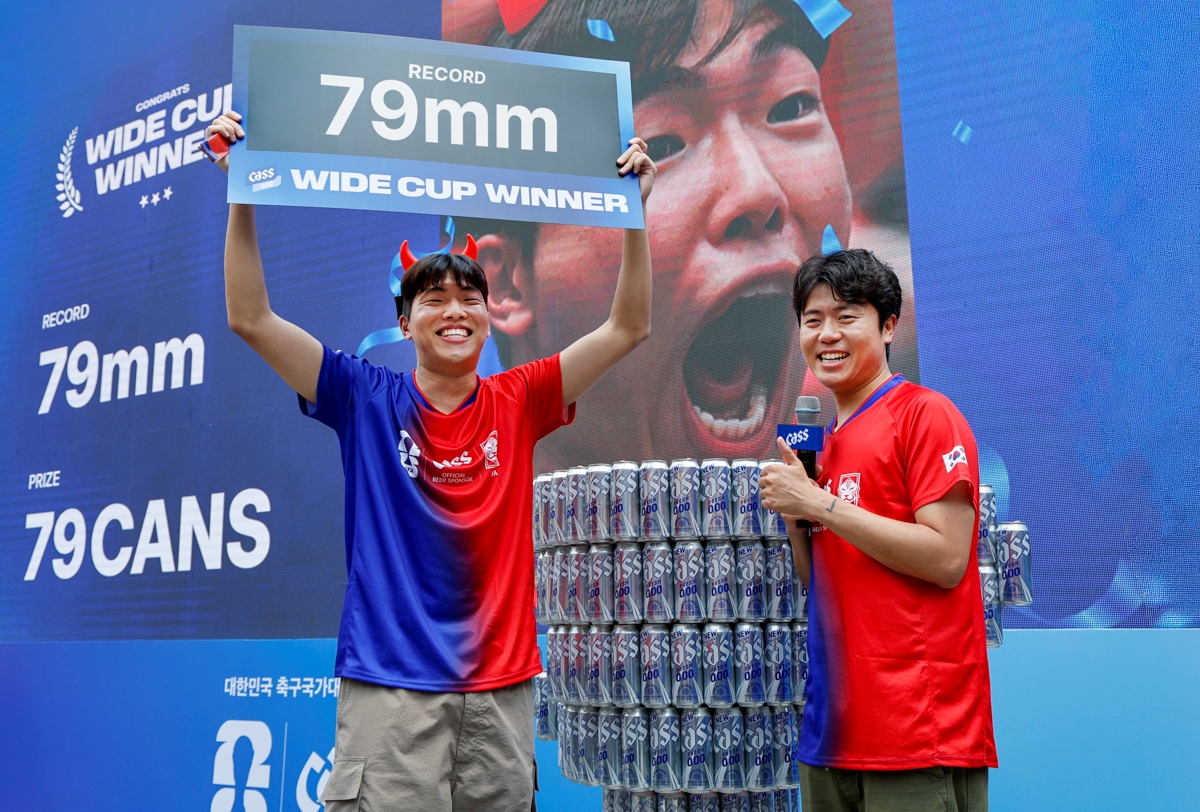
A total of 220 people took part in the first Wide Cup. The top six participants, including the first-place winner whose mouth opening measured a record 79mm, received a total of 411 cans of Cass Zero as prizes and are scheduled to appear in the Cass OOH. The Wide Cup is set to take place on the remaining two group match days.

The event will be supported by social campaigns. Fans can participate by taking photos of themselves watching the international football match and cheering on the national team wherever they are, and posting them on Instagram with hashtags #CASSZERO and #WIDECUP. Participants will be entered into a prize draw to win Cass Zero proportionate to the size of their mouth.

Hye-Yeon Seo, Vice President of Marketing at Oriental Brewery, maker of Cass, said: “As a big supporter of football fans around the world, Cass is committed to making the moments when people come together to celebrate even more special. We hope this campaign will enable consumers to experience the excitement of the world championship season up close and create a moment when 50 million become real as we cheer on the national team together.”


***

Credits

Campaign Title: Wide Cup

Client/Brand: Oriental Brewery / Cass
Marketing VP: Alexander Lambrecht
National Brands VP: Hye-Yeon Seo

Agency: Cheil Korea
Executive Creative Director: Seongphil Hwang
Copywriter: Seungree Kang
Global Copywriter: Jee-eun Park
Art Director: Taeyul Ko

Production: The Blue Studio